

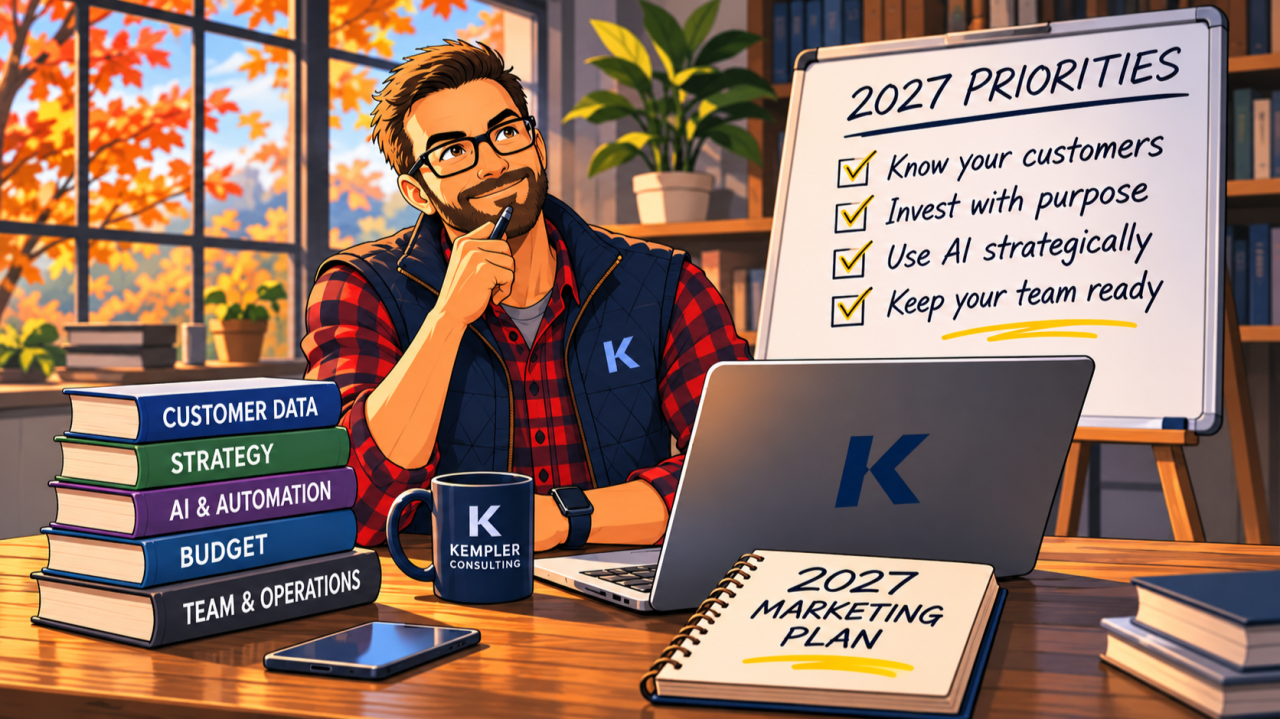
Most 2027 marketing plans start with a budget.
But some of the most valuable information you'll need to build that budget is already sitting in your customer database. And during one of the busiest stretches of the marketing calendar, your customers are giving you even more to work with.
The question is whether you're paying attention.
November is a live planning session
Marketing teams often wait until year-end reporting to evaluate what worked. But November and December offer a real-world look at how your marketing program performs under pressure.
Campaign volume climbs. Segments get tested. Automations work overtime. Your team juggles competing priorities.
Which audiences are converting? Which campaigns are driving revenue? Where are customers disengaging? Which processes are slowing your team down?
Your most useful planning insights for 2027 may be hiding in the work you're doing right now.
Your customer database is your greatest marketing asset
You pay for access to advertising platforms. Social algorithms determine how much of your content gets seen. But the customer relationships and first-party data you've built are assets you can continue putting to work.
Whether that data lives in HubSpot, Salesforce, Klaviyo, or somewhere else, it likely holds opportunities worth exploring before you invest in more reach.
Start with three moves:
- Find your most valuable customers. Look at purchase frequency, average order value, and lifetime value to identify who's driving revenue. The 80/20 rule is a useful starting point, but let your data tell the story.
- Find more customers like them. Use actual customer behavior to inform acquisition strategies and build lookalike audiences based on your best customers.
- Find more opportunities within your existing base. Explore bundles, recurring programs, VIP tiers, and lifecycle campaigns that encourage repeat business.
The more you understand your existing customers, the smarter your next investment can be.
Give your 2027 budget a reality check
A useful framework for allocating marketing investments is:
80% proven. 15% promising. 5% experimental.
Put most of your resources behind strategies delivering consistent results. Give emerging opportunities room to grow, and reserve a smaller portion for testing something new.
The right balance depends on your business, but the principle holds: use performance data to guide your investments.
Look beyond impressions, opens, and clicks to understand how your marketing contributes to qualified leads, acquisition, retention, and revenue.
AI made marketing faster. Did it make marketing better?
As AI becomes part of more marketing workflows, it's worth distinguishing between adoption and maturity.
Adoption tells you how much AI you're using. Maturity shows up in the results.
Are campaigns performing better? Is personalization more relevant? Are efficiency gains creating measurable value?
AI can accelerate segmentation, content development, and automation, but its effectiveness still depends on the data, strategy, and human expertise behind it.
Give AI an outdated customer segment and it can help you reach the wrong audience faster.
Your 2027 strategy starts with what you're learning today
As you plan for next year, pay attention to the customers, campaigns, and channels driving results. Look for opportunities in your existing technology and processes.
And don't overlook your team. Peak campaign season can expose operational gaps through rushed creative, repetitive messaging, missed QA steps, and personalization that quietly stops working.
At Kempler Consulting, our specialists work inside your team and your existing MarTech stack, helping address the execution challenges that can hold good strategies back.
Your best 2027 marketing opportunities may already be hiding in your 2026 results.